It reads your register first instead of forcing one generic voice
A good human editor does not rewrite a technical manual like a personal diary, or turn a casual blog post into corporate legal copy. When you request a revision, Wuffi’s collaborator inspects the register, sentence length, and punctuation of your draft and adjusts automatically:
- Personal essays, blogs, and commentary: Preserves your first-person perspective, dry humor, hesitation, and natural cadence (“Honestly, I’m still not sure”). It never invents fake personal anecdotes or tacks on an inspirational moral at the end.
- Technical docs and product guides: States steps, conditions, and limitations directly while keeping exact terminology, version numbers, and code intact—without adding empty adjectives like “revolutionary” or “seamless.”
- Business, academic, and factual reports: Maintains appropriate formality, source attribution, and logical qualifiers without forcing casual slang.
Just as important: if a sentence is already clear and natural, Wuffi leaves it alone instead of rewriting it just to look busy.
Before vs. after: 5 side-by-side comparisons
Compare how an uncalibrated chatbot typically rewrites a draft (“Before”) against Wuffi’s built-in natural voice calibration (“After”):
| Writing scenario | Standard uncalibrated AI (Before) | With Wuffi voice calibration (After) | What Wuffi changed automatically |
|---|---|---|---|
| 1. Product release note | This new update truly underscores our team’s unwavering commitment to innovation. It is not just an update—it is a leap forward in productivity. It introduces CSV export, full-text search, and batch renaming. Offline editing is on the horizon—stay tuned for exciting possibilities! | This update adds CSV export, full-text search, and batch renaming. Offline editing is planned for the next release and is still being tested. | Stripped empty puffery (“underscores our unwavering commitment,” “not just an update,” “stay tuned”), removed decorative bolding, and kept the three real features plus the honest testing status. |
| 2. Personal blog essay | In today’s fast-paced digital landscape, choosing the right writing tool is of paramount importance. Make no mistake—speaking my rough drafts out loud has unlocked a seamless, efficient, and transformative workflow. | When I get stuck on a long article, I usually end up staring at the blank page. Speaking the first draft out loud leaves me with rough sentences, but at least I get past the opening paragraph. | Removed throat-clearing (“In today’s fast-paced digital landscape”), defensive filler (“Make no mistake”), and the forced three-adjective stack (“seamless, efficient, and transformative”). |
| 3. Technical documentation | Great question! Let’s dive deep into a crucial mechanism: caching. We are currently in the process of conducting comprehensive testing on the system, and we plan to perform configuration adjustments on Friday. Hope this helps! | Caching reuses results that have already been fetched. We are testing the system and plan to adjust the configuration on Friday. | Cut chatbot pleasantries (“Great question!”, “Hope this helps!”), removed “Let’s dive deep,” and replaced wordy nominalizations (“conducting comprehensive testing”) with direct verbs. |
| 4. Research & business summary | Industry experts agree that this redesign completely eliminates user error, demonstrating its immense value. The issue was reported by the community and causes memory leaks. | Several unnamed interviewees said this design may reduce user errors. Community members reported the issue several times; it may be related to a memory leak, though the cause is not yet confirmed. | Protected epistemic boundaries: refused to inflate “unnamed interviewees said it may reduce” into “experts agree it eliminates,” or turn “may be related” into “causes.” |
| 5. Dramatic fragments & stacked clauses | This is a complete solution of fine-tuning of an open-source small model of one billion parameters. The file is gone. Vanished. Never to be found again. We have no backup. | This is a complete fine-tuning setup for a one-billion-parameter open-source model. The file was lost, and we do not have a backup. | Untangled stacked prepositions and merged repetitive dramatic fragments (“Gone. Vanished. Never to be found again.”) into one factual statement. |
6 categories of AI clichés automatically filtered out
Whenever you press Alt + A to revise a selection, Wuffi checks the proposed rewrite against six common failure modes:
- False contrasts and throat-clearing: Cuts “It’s not X, it’s Y,” “Let’s dive in,” and “Here is what you need to know.”
- Formulaic rhythm: Avoids mechanical three-adjective lists (“innovative, groundbreaking, and seamless”), em-dash chains used for fake suspense, and invented hyphenated buzzwords.
- Puffery and borrowed authority: Drops “pivotal,” “testament to,” “marks a new era,” and vague appeals to unnamed experts.
- Decorative formatting and chat residue: Removes unnecessary bolding on ordinary nouns, decorative emojis in headings, and chatbot sign-offs (“Great question!”, “Let me know if you need anything else”).
- Bloated verb phrases and stiff passives: Replaces “conduct an investigation into” with “investigate,” and untangles stacked modifiers while keeping legitimate technical terms intact.
- Empty wrap-up endings: Deletes “In conclusion, only time will tell what the future holds” so your section ends on real substance.
Facts and uncertainty stay intact—never exaggerated for style
The biggest risk of standard AI rewriting is silent hallucination: a model invents a metric to make a sentence sound concrete, or turns a cautious “might” into a confident “will.” Wuffi’s calibration puts factual accuracy and degree of certainty first:
- No invented specifics: If your draft does not state a percentage, date, or source, Wuffi keeps the same level of generality rather than making up numbers.
- Qualifiers are preserved: Words like “may,” “reportedly,” “planned,” and “only when caching is enabled” keep their exact scope and uncertainty.
- Markdown and code protection: Fenced code blocks, inline code, URLs, file paths, table values, and heading hierarchies are never altered during prose polishing.
Calibrated voice + sentence-by-sentence review
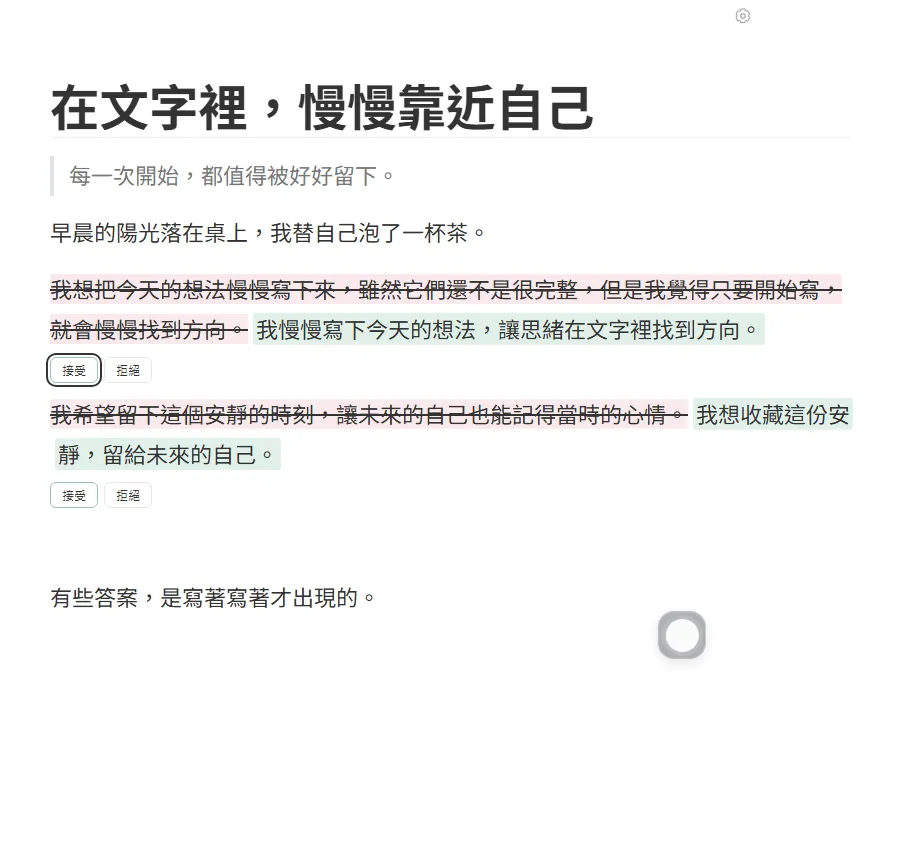
Even with built-in voice calibration, Wuffi never overwrites your paragraph behind your back. Every proposed edit appears inline inside your Markdown document so you can click Accept on the sentences that work and Reject on the ones you prefer to keep as written. Unaccepted suggestions are never included when you save, copy, or export to .md, PDF, or Word.
Read more in our online AI Markdown editor guide and Markdown to PDF and Word export guide.
Common questions
Do I need to type a special prompt to get natural, human-sounding edits?
No. These calibration rules are built directly into Wuffi’s writing collaborator. Just select a passage, press Alt + A, and ask for what you want in plain language (such as “tighten this paragraph” or “make this clearer”).
Does it work across English, Traditional Chinese, and Japanese drafts?
Yes. The collaborator replies and edits in the language of your document, applying both cross-language anti-cliché rules and language-specific cleanup automatically.
Will it rewrite sentences that are already fine?
No. It is instructed to leave clear, natural sentences untouched—and if you disagree with any suggested sentence, you can reject it with one click right in the article.